 by
by Landing your first job begins with a well-crafted entry-level intelligence analyst resume.
Whether you're applying to a government agency, defense contractor, or private firm, your document needs to clearly demonstrate analytical skills, attention to detail, and a basic understanding of information gathering.
In this guide, you'll learn how to structure your resume, which abilities and keywords to highlight, and how to present your education or internship experience in a way that aligns with industry expectations.
Entry-level intelligence analyst resume examples
- Open-source intelligence (OSINT) analyst resume
- Signals intelligence (SIGINT) analyst resume
- Geospatial intelligence (GEOINT) analyst resume
Entry-level OSINT intelligence analyst resume sample
Entry-level OSINT intelligence analyst resume template
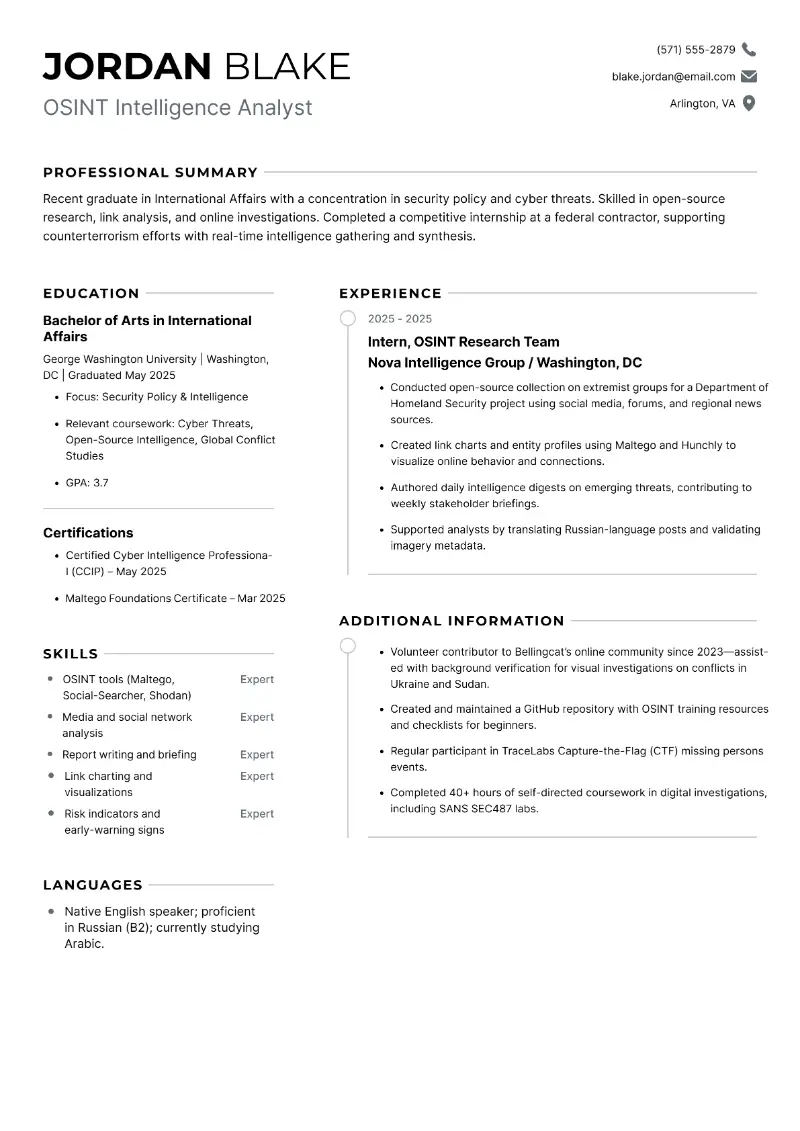
Resume for entry-level OSINT intelligence analyst | Plain text
Jordan Blake
blake.jordan@email.com | (571) 555-2879 | Arlington, VA | LinkedIn.com/in/jordanblakeSummary
Recent graduate in International Affairs with a concentration in security policy and cyber threats. Skilled in open-source research, link analysis, and online investigations. Completed a competitive internship at a federal contractor, supporting counterterrorism efforts with real-time intelligence gathering and synthesis.
Skills
- OSINT tools (Maltego, Social-Searcher, Shodan)
- Media and social network analysis
- Report writing and briefing
- Link charting and visualizations
- Risk indicators and early-warning signs
- Web scraping (Python, BeautifulSoup)
- Cultural and linguistic context analysis
- Geolocation techniques
- Time management
- Critical thinking
Experience
Intern, OSINT Research Team
Nova Intelligence Group | Washington, DC | Jan 2025 – Apr 2025
- Conducted open-source collection on extremist groups for a Department of Homeland Security project using social media, forums, and regional news sources.
- Created link charts and entity profiles using Maltego and Hunchly to visualize online behavior and connections.
- Authored daily intelligence digests on emerging threats, contributing to weekly stakeholder briefings.
- Supported analysts by translating Russian-language posts and validating imagery metadata.
Education
Bachelor of Arts in International Affairs
George Washington University | Washington, DC | Graduated May 2025
- Focus: Security Policy & Intelligence
- Relevant coursework: Cyber Threats, Open-Source Intelligence, Global Conflict Studies
- GPA: 3.7
Certifications
- Certified Cyber Intelligence Professional (CCIP) – May 2025
- Maltego Foundations Certificate – Mar 2025
Languages
- Native English speaker; proficient in Russian (B2); currently studying Arabic.
Additional Information
- Volunteer contributor to Bellingcat’s online community since 2023—assisted with background verification for visual investigations on conflicts in Ukraine and Sudan.
- Created and maintained a GitHub repository with OSINT training resources and checklists for beginners.
- Regular participant in TraceLabs Capture-the-Flag (CTF) missing persons events.
- Completed 40+ hours of self-directed coursework in digital investigations, including SANS SEC487 labs.
Strong sides of this intelligence analyst resume example:
- Clearly highlights technical tools and platforms relevant to open-source investigations.
- Includes multilingual capability and real-world volunteer experience in intelligence gathering.
- Structured with a clean summary and detailed project-based internship contributions.
Formatting your resume the right way
- Choose a legible font such as Calibri, Arial, or Times New Roman at 11–12 pt size.
- Keep the resume size to one page if you’re just starting out or have limited background.
- Maintain 1-inch margins on all sides for a tidy and uniform appearance.
- Apply consistent spacing—single line within entries, with blank lines between parts.
- Employ clear resume section headers in bold or slightly larger text to organize your layout.
- Export your document as a PDF file to preserve its look across devices.
- Align all content to the left side to make scanning easier for recruiters and software systems.
- Format responsibilities using bullet points to improve structure and readability.
To prevent formatting errors and avoid starting from scratch, try an online resume builder free of charge.
Resume Trick offers functional resume templates that are time-saving and visually polished.
Create your professional Resume in 10 minutes for FREE
Build My Resume
Entry-level SIGINT intelligence analyst resume example
Sample entry-level SIGINT intelligence analyst resume
Ava Mendoza
ava.mendoza@email.com | (512) 555-4938 | San Antonio, TX | GitHub.com/avamendozaSummary
Highly motivated entry-level signals intelligence analyst with a background in electrical engineering and cybersecurity fundamentals. Experienced in waveform analysis, signal interception, and military communications through coursework and a summer internship at a defense contractor. Interested in supporting national security through actionable SIGINT products.
Skills
- Signal acquisition and analysis
- Radio frequency spectrum monitoring
- SDR (Software Defined Radio) tools
- Technical report creation
- Python and MATLAB for signal processing
- Wireshark and protocol analysis
- Cryptologic fundamentals
- Electronic surveillance
- Team collaboration
- Problem-solving
Experience
Summer Intern, Signals Intelligence Department
Raytheon Technologies | San Antonio, TX | Jun 2025 – Aug 2025
- Assisted with the monitoring and analysis of RF transmissions using GNU Radio and HackRF SDR for a DoD-sponsored research program.
- Created basic signal profiles and categorized anomalies in intercepted data to support real-time decision-making.
- Contributed to documentation and QA testing of new signal recognition algorithms in Python.
- Participated in daily team briefings, contributing technical summaries and waveform observations.
Education
Bachelor of Science in Electrical Engineering
University of Texas at San Antonio | San Antonio, TX | Graduated May 2025
- Emphasis in Signal Processing and Communication Systems
- Relevant Courses: Digital Signal Processing, Cryptography, Communication Networks
- GPA: 3.8
Certifications
- CompTIA Security+ – Feb 2025
- GNU Radio Workshop Certificate – Jul 2024
Additional Information
- Fluent in Spanish; currently learning Mandarin for regional signal analysis roles.
- Built a functional SDR scanner setup using HackRF and GNU Radio—published personal blog with tutorials and demos.
- Member of the Association of Old Crows and SIGINT Professionals Network.
- Mentored by a retired NSA analyst through Women in Defense mentorship program.
- Completed 30-hour cyber operations simulation hosted by Texas A&M Defense Innovation Lab.
This example of an intelligence analyst resume is solid:
- Effectively ties academic expertise in engineering to signals analysis skills.
- Emphasizes hands-on work with SDR tools and RF spectrum technologies.
- Demonstrates cybersecurity awareness through certifications and lab experience.
Should I choose an analyst resume objective or summary?
Choose a summary on a resume if you have internship exposure, military background, or projects in analysis.
- It provides a snapshot of what you bring to the table.
Entry-level intelligence analyst resume summary sample:
Detail-oriented analyst with hands-on experience from internships in open-source research. Skilled in risk analysis, data interpretation, and intelligence reporting. Eager to contribute actionable insights to government or defense sectors.
Go with a resume objective statement if you’re a recent graduate or pivoting into intelligence.
- It briefly states your career direction and enthusiasm for the role.
Entry-level intelligence analyst resume objective example:
Criminal justice graduate seeking an entry-level intelligence analyst role to apply research and analytical training in support of national security objectives.
How to showcase your intelligence analyst resume skills?
The skills section of resume lets employers quickly assess your abilities.
- Hard skills involve specific methods, software, and procedures used in intelligence work. They are usually learned through classes, certifications, or self-study.
- Soft skills reflect how you approach tasks, communicate, and collaborate. These are developed through work experience, internships, or extracurriculars.
Intelligence analyst hard skills examples:
- OSINT tools (e.g. Maltego)
- ArcGIS / QGIS
- Link analysis
- Structured analytic techniques
- SQL
- Python
- Data visualization
- Risk assessment
- Geospatial intelligence (GEOINT)
- Threat modeling
- Cybersecurity basics
- Report writing
- Intelligence cycle knowledge
- Metadata analysis
- Microsoft Excel (pivot tables, VLOOKUP)
Soft skills for intelligence analysts samples:
- Critical thinking
- Problem-solving
- Written communication
- Verbal communication
- Collaboration
- Attention to detail
- Time management
- Initiative
- Ethical judgment
- Adaptability
- Analytical mindset
- Research ability
- Curiosity
- Professionalism
- Organization
Entry-level GEOINT intelligence analyst resume template
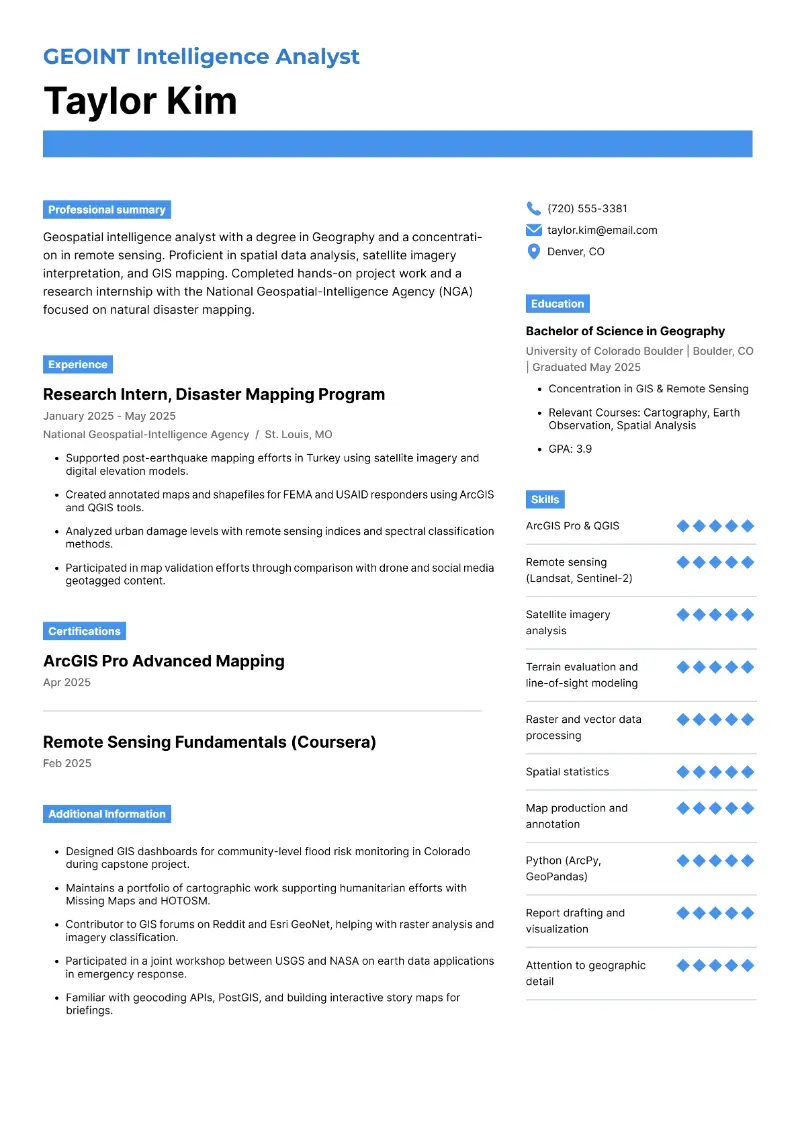
Entry-level GEOINT intelligence analyst resume sample
Resume for entry-level GEOINT intelligence analyst | Text version
Taylor Kim
taylor.kim@email.com | (720) 555-3381 | Denver, CO | Portfolio: taylorkimmaps.comSummary
Geospatial intelligence analyst with a degree in Geography and a concentration in remote sensing. Proficient in spatial data analysis, satellite imagery interpretation, and GIS mapping. Completed hands-on project work and a research internship with the National Geospatial-Intelligence Agency (NGA) focused on natural disaster mapping.
Skills
- ArcGIS Pro & QGIS
- Remote sensing (Landsat, Sentinel-2)
- Satellite imagery analysis
- Terrain evaluation and line-of-sight modeling
- Raster and vector data processing
- Spatial statistics
- Map production and annotation
- Python (ArcPy, GeoPandas)
- Report drafting and visualization
- Attention to geographic detail
Experience
Research Intern, Disaster Mapping Program
National Geospatial-Intelligence Agency | St. Louis, MO | Jan 2025 – May 2025
- Supported post-earthquake mapping efforts in Turkey using satellite imagery and digital elevation models.
- Created annotated maps and shapefiles for FEMA and USAID responders using ArcGIS and QGIS tools.
- Analyzed urban damage levels with remote sensing indices and spectral classification methods.
- Participated in map validation efforts through comparison with drone and social media geotagged content.
Education
Bachelor of Science in Geography
University of Colorado Boulder | Boulder, CO | Graduated May 2025
- Concentration in GIS & Remote Sensing
- Relevant Courses: Cartography, Earth Observation, Spatial Analysis
- GPA: 3.9
Certifications
- ArcGIS Pro Advanced Mapping – Apr 2025
- Remote Sensing Fundamentals (Coursera) – Feb 2025
Additional Information
- Designed GIS dashboards for community-level flood risk monitoring in Colorado during capstone project.
- Maintains a portfolio of cartographic work supporting humanitarian efforts with Missing Maps and HOTOSM.
- Contributor to GIS forums on Reddit and Esri GeoNet, helping with raster analysis and imagery classification.
- Participated in a joint workshop between USGS and NASA on earth data applications in emergency response.
- Familiar with geocoding APIs, PostGIS, and building interactive story maps for briefings.
This sample beginner intelligence analyst resume is good for several reasons:
- Features direct NGA internship with mission-focused geospatial analysis.
- Strong emphasis on mapping software, remote sensing, and visualization tools.
- Clear portfolio mention adds credibility and showcases applied cartography skills.
What academic credentials should I put on my resume?
For those entering the field, the education section in a resume often plays the biggest role in getting noticed. It highlights your foundation in relevant areas such as political science, cybersecurity, or criminal justice.
Sample structure of an education section for an analyst:
- Degree name (e.g. Bachelor of Arts in International Relations)
- University name and location
- Graduation date (or expected year)
- Relevant coursework or projects
- Academic honors like cum laude (if applicable)
- GPA (if above 3.5)
- Certifications (related to intelligence or analysis)
How to organize the experience section of an analyst resume?
- Highlight internships or projects related to analysis, research, or investigation.
- Use action verbs like "evaluated," "identified," "supported," or "compiled."
- Quantify accomplishments or contributions to make them measurable.
- Reference tools, software, or research methods to show technical fluency.
- Emphasize transferable analytical abilities from other roles or experiences.
- Start bullet points with a relevant keyword to align with job descriptions.
Conclusion
An effective entry-level intelligence analyst resume should balance technical knowledge with clear communication, adaptability, and a deep curiosity about global affairs.
By highlighting relevant coursework, certifications, soft skills, and analytical tools, you position yourself as a strong candidate even without years of experience.
Use tailored sample resumes and action verbs to show recruiters you understand the demands of the role—and that you’re ready to meet them.
Create your professional Resume in 10 minutes for FREE
Build My Resume